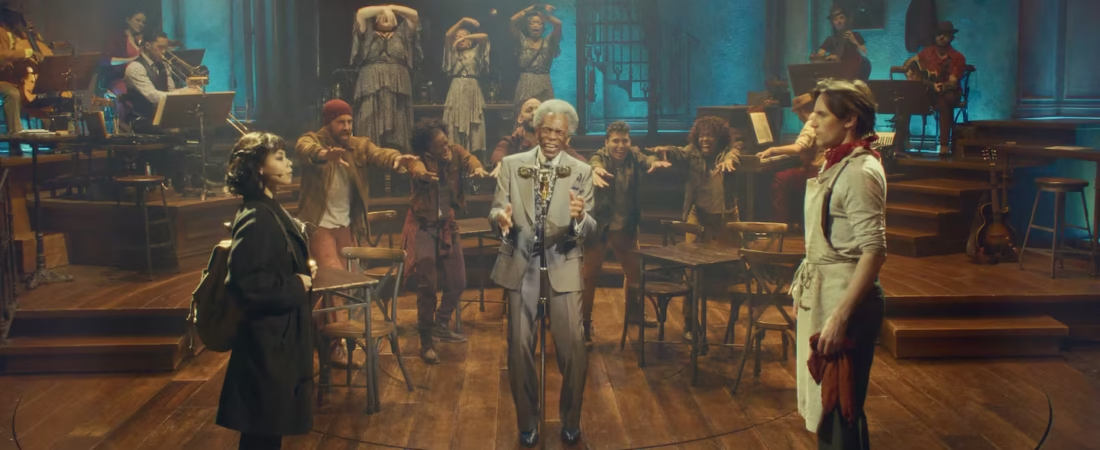
What is Hadestown? To my surprise, that is a question I’ve heard a lot of people ask over the last couple of weeks. It’s a thought I had myself just a few months ago, having no idea what I was getting into. Hadestown is an acclaimed Broadway musical, widely regarded as one of the modern greats of the art form. Today, a pro-shot (a filmed recording of the live stage performance featuring the iconic original Broadway cast) was released in movie theaters across the country.
I caught the 2:45 pm showing today, sitting in an empty theater to experience it. Maybe it was because I watched it at a bad time, but regardless, this baffled me. I think that I was expecting a crowd because of my own personal connection to the musical, but ultimately the mainstream isn’t as familiar with it. Personally, I had been counting down the days for this to release as if it were an Avengers movie. My obsession didn’t happen overnight, but looking back, it all traces back to a significant moment in my life.
In my senior year of high school, for whatever reason, I suddenly became immersed in the world of musical theater. Hamilton quickly became my favorite piece of media, and that newfound passion eventually led me to join our school production. Once I stepped into that world, talking about shows became a daily routine. I built a close-knit group of friends who shared a fantastic dynamic, and in our discussions, one specific title always piqued my curiosity: Hadestown. They described it as a wondrous masterpiece, making me realize my knowledge of theater was still pretty shallow.
They told me I’d love it because, much like Hamilton, it’s entirely sung-through, meaning I could listen to the original cast recording and get the full story rather than resorting to watching a pirated recording on YouTube. The first time I played it, I didn’t quite get it. It was so thick with poetry, jazz roots, and mythology that it was easy to get lost. However, the more I listened, digested the lyrics, and dissected it with my friends, the deeper I fell in love. Hadestown became the soundtrack to our friendship, sparking a chapter of my life that I still look back on with immense fondness.
Watching this pro-shot didn’t just serve as a way to smile at good memories; it reminded me how genius the story is. It is an adaptation of the Greek myth of Orpheus and Eurydice with an intentionally ambiguous setting. Rather than relying on an ancient Greek aesthetic, it incorporates trains, telephone wires, and industrial machinery, implying a world closer to Depression-era America. The original myth follows Orpheus, who falls in love with Eurydice before she tragically dies and is taken to the Underworld. Desperate, Orpheus travels down and sings a song to Hades to convince him to free his lover. This premise alone is perfect for a musical; there is so much you can do with a song written to negotiate with the king of the underworld. However, what Hadestown does is so much better.
Hadestown isn’t just one love story; it is two of them running in parallel. Alongside Orpheus and Eurydice, we see Hades and Persephone struggling with their own fractured marriage. Persephone loses her love for Hades because of his constant, obsessive expansion of his factory. He claims it’s all to provide for her, but it ultimately drives her away. This dynamic perfectly mirrors Orpheus. He becomes so fixated on writing his song to balance the seasons for Eurydice’s sake that he neglects to actually show her attention, leaving her to suffer in the cold and make the fateful decision that drives the plot.
Unlike the original myth, Eurydice chooses to go to Hadestown out of desperation for survival and comfort, leaving Orpheus behind to realize that his carelessness caused the love of his life to walk away. This realized fear is the same fear Hades struggles with, which is the root of all his greedy actions: an insecure attempt to build a world where Persephone can never leave him. This reflection crescendos beautifully when Orpheus travels to Hadestown to free Eurydice and sings the exact melody Hades sang to Persephone when they first fell in love, saving their marriage and redeeming him. These layered story motifs make Hadestown a masterpiece in storytelling.
The characters are brilliant as well. Eurydice sees the world as a brutal place due to her harsh environment and is wary of human betrayal. Orpheus, on the other hand, sees the world as it could be. He is an idealist, full of hope and a dreamer’s light. That is, until harsh reality hits him with the devastating truth: nobody forced Eurydice to go to the Underworld; she chose it. I cried three times watching this pro-shot: during Orpheus and Eurydice’s initial love song, during the emotional climax, and during “If It’s True,” the song where Orpheus faces this grim reality and grows to rise above it. It’s a truly heartbreaking sequence, and perhaps my favorite character beat in any media. In that single song, he transitions from a gentle dreamer into a determined revolutionary willing to stand up against the King of Hell himself.
The final aspect of the story I want to touch on is the ending. The original myth ends with Hades freeing Eurydice but only if she follows behind Orpheus on the walk back home. Though, if Orpheus looks back at her to see if she is still following, she will be sent back to the underworld forever. Driven by doubt, he ultimately looks back and ends the myth as a tragedy. This is a classic ending that most of the audience would know when watching a musical adaptation of the myth. However, the production to this point had been so enhanced and amazing that you start to think that maybe they changed the ending. That is, until the sudden moment where he looks back, and you’re left there speechless. At first, I was confused: why would he go all this way to save his love only to have doubts and look back, essentially ruining all his progress?
Some people may say it is because of a lesson that needed to be shared, like Romeo and Juliet. Sure, you could say that it’s teaching that doubt is bad, but this carries a deeper meta reason. We all knew this ending would happen, yet we watched and enjoyed anyway. Even in the first song, Hermes explains that “it’s a sad song, it’s a tragedy, but we’re gonna sing it anyway.” Why do we tell this story again and again if we know how it ends? It comes down to a fundamental human refusal to accept defeat. We are just like Orpheus: we put our faith in how the world could be, clinging to the hope that maybe this time, it will turn out differently. That is the true beauty of Hadestown. It shows us that even when the outcome is set in stone, believing in a better world is always worth the song.
The final, most personal impact of this pro-shot was the reflection it prompted afterward. After the lights came up, I thought about those high school friends. This show had originally united me with truly genuine people, yet watching it again forced me to confront why they are no longer in my life. The truth is, I turned my back on them and theatre whenever other opportunities came along that seemed to benefit me more. I realized I was just like Eurydice, taking what looked like the easier path instead of holding onto a real connection, only to learn that the easy way isn’t always better. That is the true power of a theatrical pro-shot. Beyond the phenomenal camera work, crisp audio mix, and rich color grading, the greatest part of the screening was the chance to relive a passion that defined one of the best eras of my life. For two hours, I was back in that community, obsessing over lyrics and humming showtunes just like I used to.
It’s why studios need to release more pro-shots. They are vital time capsules for theater kids, casual fans, and anyone who hasn’t stepped into a theater in years, protecting incredible shows from becoming lost media. Overall, this was the best cinema experience of my summer, and I only wish there had been a packed house to share it with. In the end, Hadestown reminded me that while genuine connections and past passions can slip away when we look in the wrong direction, art like this gives us a chance to listen again. It’s a sad realization, but as long as these pro-shots exist to keep the music alive, we’re gonna keep singing it anyway.
Final Count:
9.8/10
Written by James Michael Counts


Leave a Reply